Beno’s Son
2022Documentary Feature Film, 102:29′
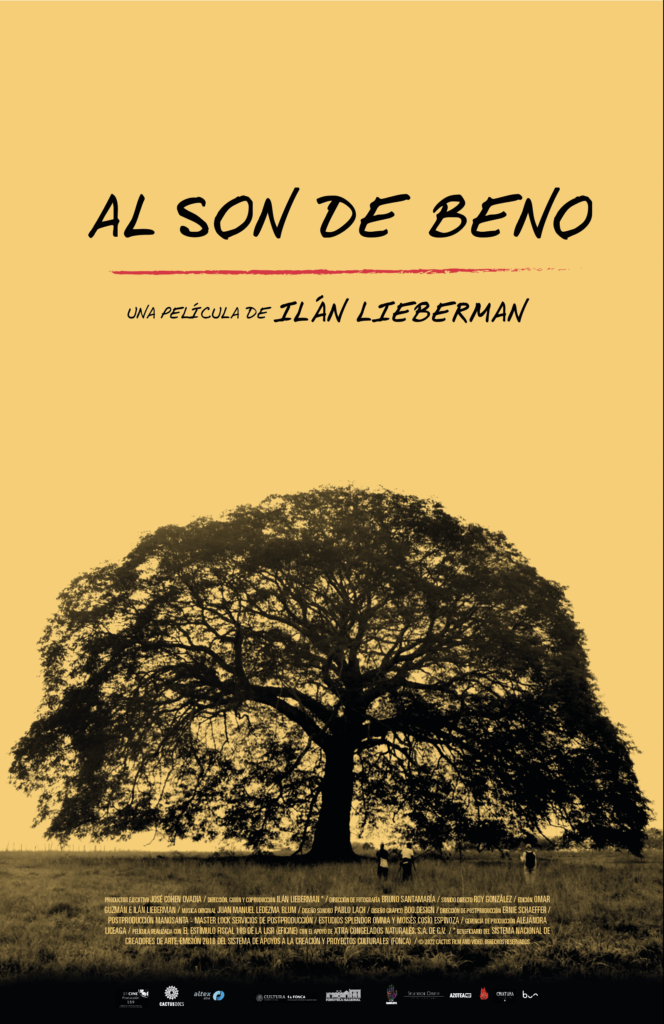
Synopsis: Ilán, a fifty-two-year-old visual artist, takes his family on a musical road trip, trying to reconstruct the chaotic, creative life and tragic death of his father, Beno Lieberman, a pioneer of folklore research in Mexico. Revisiting remote mountainous and jungle villages, they listen to local musicians – some of whom Beno recorded in the 1960s and ‘70s – who continue to play the very same music today. As Ilán confronts the mystery and pain of his father’s suicide, his son and two daughters pose difficult questions that address the reasons for the silence that often surrounds the act of suicide. And, while exploring the richness, intensity and variety of authentic Mexican folk tradition, Ilán comes to terms with his feelings about his father by opening up to his children and sharing Beno’s enduring musical legacy.
Watch movie online
Buy SONtrack double LP vinyl
https://reyvinilo.com/tienda/al-son-de-beno/
“The impossible forgetting.
Every time you forget, it is death that you remember by forgetting.”
Waiting Oblivion
Maurice Blanchot
“Ay, what does it matter
What does it matter, let’s go and see
To see how the water flows
Let’s go see it flow”
La mariquita (Traditional song)
They are [Ellos son]
The film Al son de Beno (Beno’s Son; Ilán Lieberman, 2022, Mexico, 103 min.) carries a guarantee of allusions in its title: dancing to the rhythm of the strings played by Baruj ‘Beno’ Lieberman (1932-1985), which are also the tightrope strings of Ilán Lieberman, his son.
The son to which the title alludes is the son huasteco, a genre to which Beno dedicated a large part of his research—work fundamental to the understanding of traditional Mexican music. Beno Lieberman, along with Eduardo Llerenas and Enrique Ramírez de Arellano, were independent researchers who, between 1971 and 1983, recorded just over a thousand musical pieces that form the legendary Antología del son de México (six LPs, 1981), now a collector’s item and one of the treasures of the Mexican National Sound Archive (Fonoteca Nacional).
Ilán Lieberman makes a visual pact with the echo of his father’s sound. The echo of Beno’s son remains and “touches from a distance.”¹ But its English title—Beno’s Son—displaces the father and places Ilán, Beno’s son, at the center. It is also a dedication to Beno’s son: dedicated to his music? To his son? In any case, son (in its different meanings: “son huasteco,” “sound,” “echo,” “son”) is, above all, the verb to be [ser] that allows father and son to be. They are [Ellos son].
Upon turning 52, Ilán reaches the year-count of a Mesoamerican century. 52 is also the age of the limit, the age of the threshold: the age at which Ilán will become older than his own father, who at 52 ended his life, only days after the 1985 Mexico City earthquake.
Al son de Beno proposes breaking with the definitive, the exceptional event: to speak the pain of the father’s loss to oneself, referring back to an original anguish. Boarding a Honda, in a road movie accompanied by his children Ana, Bruno, and Cora, Ilán begins a journey through Guerrero, Veracruz, Oaxaca, and the Huasteca Potosina, chasing the ghost of Beno Lieberman, who left musical footprints in his wake—footprints of deep song, sealed in stone and impregnated in the jungles. In his expedition, Ilán gives his family—and, above all, procures for himself—a metamorphic knowledge: that knowledge of which Roberto Calasso spoke “that transforms the one who knows at the moment he knows.”²
Ana, in the back seat on the highway, asks: “What are you looking for regarding yourself?” “That is the question,” Ilán replies reflectively at the wheel.
It is, in any case, about organizing a diurnal conspiracy. To pursue by the light of Day what Ilán has already pursued all his life through the Night. That original Night of his. All the sequences in the film are strictly diurnal. Ilán Lieberman brings his Night into the Day. This is one of the traits of his wisdom, distilled in strictly artistic terms.
Beno, his guide, is a being in flight. He is the ghost who officiates and shapes his perception. Sometimes, Beno is atmospheric. He is the melancholy mist covering the mountains of Guerrero. A mist of escaped experience.
Beno Lieberman was a being full of dark light. He knew that eternity resided in every plucked note and acted as if he were to die at any moment. He was a prey to the euphone: sometimes he spoke with God or listened to the “bird-singer” of the forests. Other times, he fled the mental asylum aided by his friends. At others, he founded the Mexican Folklore Association, El Pesebre. Sometimes he recited his own poems on TV. In short, Beno was someone who “played his part with consistency,”³ as Nikos Kazantzakis wrote, and Ilán delivers an intimate film that portrays the father—while simultaneously portraying himself—which remains resonating inside you like a jarana, a lament of the treble guitar, and a son huasteco voice that bends into a falsetto: ¡ay! ¡ay! ¡ay! ¡ah-ya-yai!
Two fundamental traits: to give us his father, Ilán—a painter—uses cinema: the phosphorescence of nothingness, the black light. And he uses drawing to say the unspeakable.
If Beno remains primarily in his sound, the pencil portraits of Beno are the visual pact with his echo. Ilán tries to circumscribe his father’s face in a drawing, over and over again. And the likeness falls behind with each new variant. Drawing has a transformative power. Each portrait offers variations of the intensities of the father’s face. And the physiognomic variants show Beno’s face in a “cloud state.”
All the characters in this emotional drama are the varied faces of his drawings. Beno-Bruno, Beno-Ari, Beno-Eitan, Beno-Cora, Beno-Brenda, Beno-Laila, Beno-Benjamin, Beno-Ana, Beno-Ilán. Beno-Beno, Beno-Samuel, etc. A multiple face that, thanks to Ilán’s drawings, is strangely familiar to us despite its transformation—or rather, strangely familiar because of its transformation, which is its resemblance, its kinship, and its likeness.
It is well known that every drawing has the sacred muteness of a hieroglyph, but it would be more appropriate to say that these are not portraits in drawing but chords of Beno’s face—each stage of the echo: a drawing, a transformation of his sound—which is like that “chord-avalanche” of which conductor Daniel Barenboim speaks,⁴ that first note after which all others fall like a waterfall.
What is the original source of this waterfall, of this son? Where is the Lieberman sonority born? Where are they from [De dónde son]? From the desert. Like The Book. From the original source of this family tree, “relay-fruits” fall through three generations. Don Samuel Lieberman, the grandfather, sent reel-to-reel tapes from Israel to his children in Mexico. We hear a soul-stirring fragment of a miniature Torah that Don Samuel (with a voice like Isaac Bashevis Singer) accompanied with advice on how not to kill oneself. The grandfather’s cassettes as sonic inheritances: sonic relays for the future.
These sonic relays enter the space of dreams.
Dreams, in the film, are drawings. Ilán dreams he receives a phone call from Beno. He tells him he is doing very well, recording sones as he used to do and enjoy in life. In another dream, Ilán receives a letter from Beno where he expresses in writing his willingness to collaborate on his film (he knows Ilán is filming it!), pointing out where to find photo albums. And the relay he carries like a dybbuk⁵ is a drawing: in a self-portrait in motion, Ilán drags a suitcase that contains the pistol—the definitive relay—with which Beno is to shoot himself that day in September 1985.
In the film, the drawing said the unspeakable.
This does not, however, stop the flow and continuity of relays: from the grandfather’s cassettes to Beno’s open-reel tapes, Ilán Lieberman delivers a film-ordeal of extraordinary beauty.
Otto Cázares
August 2023
¹ Expression of Emmanuel Levinas. Levinas, Emmanuel, Proper Names.
² Calasso, Roberto. The Celestial Hunter.
³ Kazantzakis, Nikos. Zorba the Greek.
⁴ Barenboim, Daniel; Chéreau, Patrice. Dialogues on Music and Theater.
⁵ Hebrew word meaning ghost or spirit.